Larbi Ben M'hidi
Mohammed Larbi Ben M'hidi
Ben M'hidi portrait
Born 1923
Aïn M'lila, French Algeria
(now Algeria)
Died 4 March 1957 (aged 34)
Algiers, French Algeria
(now Algeria)
Cause of death Executed
Resting place El Alia Cemetery,
Algiers, Algeria
Other names El Hakim (seigneur)
Organization ALN
Political movement FLN, CRUA, OS, MTLD
Religion Islam
Mohammed Larbi Ben M'hidi (1923–1957) (Arabic: محمد العربي بن مهيدي), commonly known as Larbi Ben M'hidi or simply as Ben M'hidi, was a prominent Algerian leader during the war of independence. He is regarded as one of the nine historic chiefs (chefs historiques) of the Algerian revolution against French colonialism.
Ben M'hidi initially commanded Wilaya V (the military district in the Oran region) and played an important role at the FLN's Soummam conference in August 1956. He headed FLN operations during the Battle of Algiers where he was the last member of the FLN's Comité de Coordination et d'Exécution (CCE; Committee of Coordination and Enforcement). Ben M'hidi was a strong believer in that the revolution should be directed by "internal" rather than "external" revolutionaries.[1]
He was captured by French paratroopers in February 1957. His death was announced in March 1957 by Robert Lacoste's press officer. The events surrounding his death were disputed by many, and contended that he was in fact tortured and executed. In 2000, General Aussaresses admitted that Ben M'hidi was executed. Ben M'hidi is considered to be a national hero in Algeria.
Contents [hide]
1 Early life
2 Rebellion
3 Capture
3.1 Execution
4 References
5 Further reading
Early life[edit]
Larbi Ben M'hidi was born sometime in 1923 in the village of El Kouahi, Ain M'lila, which was part of the Constantine department at the time. He was the youngest of six children. He attended a French primary school for his first school year, and then transferred to a school in Batna, so that he could continue his studies – this is where he received his primary school certificate (Certificat d'études primaires élémentaires). The Ben M'hidi family later moved to Biskra, where Larbi Ben M'hidi began secondary school. In 1939, he joined the Algerian Muslim scouts, where he became a group leader within a very short period of time.
Rebellion
"Groupe des six", heads of FLN. Larbi Ben M'hidi is seated, right.
Ben M'hidi became a follower of Messali Hadj and was a member of Hadj's Algerian People's Party (PPA) during World War II, rapidly obtaining significant responsibilities within the movement. Ben M'hidi was arrested at the time of the Sétif uprising in 1945 against the occupying French forces.[2] The uprising was suppressed through what is now known as the Sétif massacre. On March 15, 1946, Ben M'Hidi was released from prison due to an amnesty being granted to the majority of nationalists imprisoned for the 1945 riots. The PPA was disbanded following the 1945 Sétif riots, and was replaced in October 1946 by the Movement for the Triumph of Democratic Liberties (MTLD), also headed by Messali Hadj. Ben M'hidi and eight other members of this movement soon grew impatient with Hadj, and decided to form the Revolutionary Committee of Unity and Action (CRUA), on 30 March 1954. During May and June 1954, they decided that French Algeria would be split into five areas; Ben M'hidi was assigned Zone 5, Oran.[3] On 10 October, Larbi Ben M'hidi and five other members of the CRUA approved the transformation, thus giving birth to the National Liberation Front (FLN) and the National Liberation Army (ALN). At a meeting at the Climat de France, a house overlooking Bab El Oued, the FLN decided to launch an insurrection, which broke out in the early morning of 1 November, and quickly escalated into the Algerian War.[4] The rebellion was conducted internally by Ben M'hidi, Didouche Mourad,Rabah Bitat, Krim Belkacem, Mohammed Boudiaf, and Mostefa Ben Boulaïd, while three more members (Hocine Ait Ahmed, Ahmed Ben Bella, andMohammed Khider) were operating externally in Cairo. They later became known as "The Men of November".
Ben M'hidi was designated Wilaya V (Oran), however, he encountered exceptional difficulties as the area had been recently struck by and earthquake and arms that were promised had not arrived.[5]
On 2 November 1955, Ben M'hidi took command of the Zone Autonome d'Alger (ZAA) and appointed Yacef Saadi as his aide. On 25 June 1956, a FLN tract authored by Ben M'Hidi and Abane Ramdane declared: "All executions of combatants will be followed by reprisals. For each FLN soldier guillotined, a hundred Frenchmen will be cut down."
On 20 August 1956 a congress assembled in the Soummam Valley in the Kabyle. The conference lasted 20 days ending sometime in September 1956. The French authorities had no knowledge that many of their most important adversaries were assembled in one place. [6] During the conference Ben M'hidi was elected along with Abane Ramdane and Krim Belkacem to the Comité de Coordination et d'Exécution (CCE; Committee of Coordination and Enforcement) where they were given the responsibility in running the Algerian War of Independence. In August 1956, Ben Mhidi handed over Oran to Abdelhafid Boussouf and assumed command in Algiers, as he was given the responsibility after the election for launching the Battle of Algiers.[7]
Capture
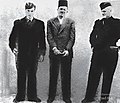
Ben M'hidi upon his arrest
Ben M'hidi was captured by Marcel Bigeard and his men on 23 February 1957. The details regarding Larbi Ben M'hidi's arrest are controversial, as there are several versions which contradict those of the French.[8] According to French sources, parachutists burst into an apartment on Rue Claude Debussy, in the European quarter, and arrested Larbi Ben M'hidi in his pajamas. Apparently they thought they were on the trail of Ben Khedda, who was another leader of the Coordinating and Executing Committee (CCE). The other members of the committee had fled to the mountains or abroad (primarily Tunis).
The photograph of his arrest was published the following day in all the newspapers in Algiers. The photograph showed Larbi Ben M'hidi with handcuffs on his wrists and ankles, but with a smile on his face.
Execution
Larbi Ben M'hidi in custody
Marcel Bigeard personally interrogated Ben M'hidi, and would not allow him to be tortured. After two weeks of questioning, Ben M'hidi showed no sign of backing down, and Bigeard grew to like and respect his prisoner. General Jacques Massu, however, was frustrated with Bigeard's slow progress, and arranged for Ben M'hidi to be transferred into the custody of Major Paul Aussaresses. Under Aussaresses, Ben M'hidi was tortured, and then driven to an isolated farm 18 kilometres south of Algiers, where he was hanged – "to make it look like suicide".[9] On 6 March 1957, Pierre Gorlin (Robert Lacoste's press officer) announced that Ben M'hidi "had committed suicide by hanging himself with strips of material torn from his shirt". His body was later transferred to a hospital in Algiers.
General Aussaresses admitted in 2000 that Ben M'hidi had been killed by the state, as had the lawyer Ali Boumendjel.[10] General Bigeard said he had respect for Ben M'Hidi and that he regretted his death.[9][11][not in citation given] Another French Army officer, Roger Trinquier, claimed that Ben M'hidi had been killed, but not tortured: "I know that all of you think we tortured him to death, but we did not ... We shot him to death, but we gave him a guard of honor before we shot him". However, Aussaresses' confession appears to contradict this account. Trinquier also regretted Ben M'hidi's death, stating: "I didn't want to shoot him. I had never met anyone like that ... I would have liked to see him as le président de la France."[12]


 ولدت الشهيدة خديجة بن يخلف يوم 29 مارس 1945 بحي الدخلة بالمدية وقد نشأت وسط أسرة تتكون من 12 فردا وكانت الشهيدة اصغر إخوتها سنا، إلتحقت
 ولدت الشهيدة خديجة بن رويسي سنة 1941 بحي الرمالي مدينة المدية ، نشأت في أسرة تتكون من ستة أفراد ، كانت توأم لأخيها عبد الله الذي استشهد هو الأخر أثناء الثورة النحريرية ، تعلمت قليلا من القرأة والكتابة ، حيث مكنتها من حفظ جزء من القرأن الكريم . تعتبر عائلة الشهيدة من الأوائل الذين احتضنوا الثورة وذلك من خلال توزيع المناشير على السكان وترتيب لقاءات مع قادة الثورة بالمنطقة . حتى تحول منزل الشهيدة إلى مركز إيواء وإتصال وعبور لجيش التحرير الوطني . وقد كلفت الشهيدة خديجة بن رويسي بعملية جمع الأخبار حول تحركات جنود العدو . وأعمال الخونة ، وظل منزل الشهيدة مقرا لإجتماعات هامة لجيش التحرير الوطني من قادة الولاية الرابعة .
 ولد سي الطيب الجغلالي سنة1916 ، ببلدية العمارية وسط عائلة فلاحية متوسطة الحال، حفظ القرآن الكريم، وتلقى شيئا من علوم الدين والفقه على يد الشيخ(رابح عليلي) التحق صفوف الحركة الوطنية سنة1937 ،حيث أسندت له مهمة تنظيم خلايا الحركة الوطنية بالمنطقة ، بالاضافة الى ارتبطاته برجال الدين أمثال:
 انه من مواليد6 نوفمبر1936 بالأخضرية ولاية البويرة، وهو من عائلة ميسورةالحال زاول دراسته الابتدائية بمسقط رأسه، ولم تسعفه ظروفه لمواصلة تعليمه المتوسط والثانوي فالتحق أنـذاك بمركز التكوين المهني أين تعلم مهنة البناء .


 This article needs additional citations for verification. Please help improve this article by adding citations to reliable sources. Unsourced material may be challenged and removed. (June 2012)
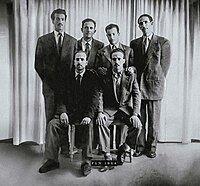
 "Groupe des six", heads of FLN. Photo before the revolution outbreak of 1 November 1954. Standing, from left to right: Rabah Bitat, Mustapha Benboulaïd, Didouche Mourad andMohamed Boudiaf. Seated: Krim Belkacem, left, and Larbi Ben M'hidi, right.